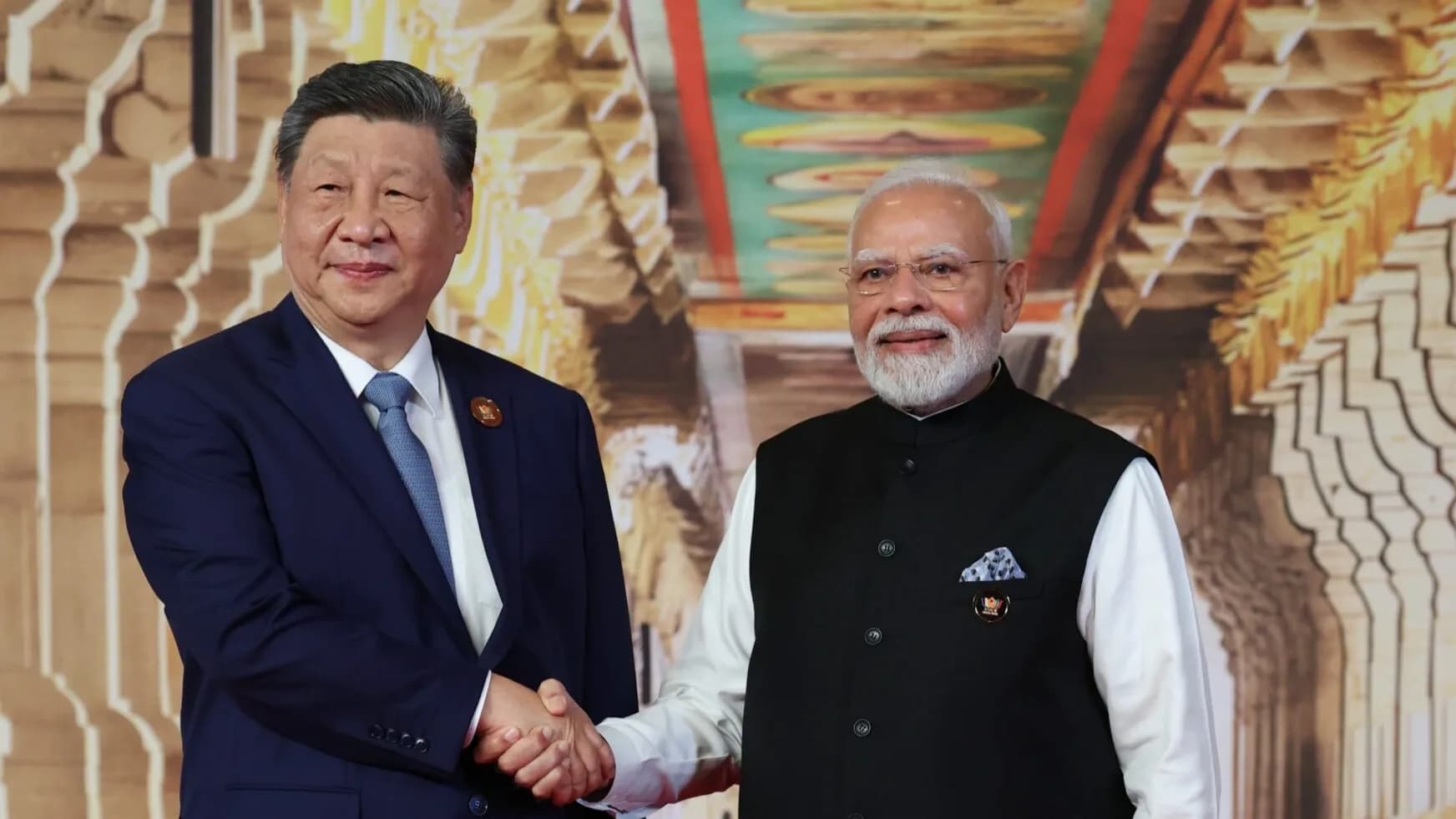
Officials on both sides were quick to dispel the rumours, saying Xi had simply chosen to rest. Leaders skipping individual events is not unusual at a multilateral summit. Their schedules are packed, they are jet lagged, and participation can vary depending on bilateral meetings, official commitments and personal choices.
Xi's visit was his first to India since the deadly 2020 Galwan clash, in which at least 20 Indian and four Chinese soldiers were killed. That episode brought the bilateral relationship to its lowest point in decades. India and China have mirrored troop deployments along the Line of Actual Control, or LAC, while several rounds of talks have taken place between senior military and diplomatic officials to reduce tensions, disengage troops from friction points and prevent another escalation. India tightened scrutiny of Chinese investment, banned several Chinese mobile applications and reduced many forms of economic and people-to-people engagement.
The first breakthrough in the ties came in late 2024 when Modi and Xi met in Kazan on the sidelines of the meeting hosted by Russia. Since then, India and China have reopened communication channels at various levels. Military patrolling has resumed at the last Ladakh face-off points. Modi and Xi met in Tianjin in 2025 and in New Delhi on September 12, where they said differences should not become disputes. Several Flights operating between various destinations in both countries have started; the number of visas being issued has increased manifold; just a month back, three border trade posts between India and China have reopened. China has allowed more pilgrims to Kailash-Mansarovar, a sacred and sensitive place for the majority of Hindus. In August 2026, the two sides agreed on new military hotlines and commander meeting points, including a first round on the Arunachal frontier.
After the recent bilateral Modi-Xi meeting, on the sidelines of the BRICS summit in Delhi, the Indian Ministry of External Affairs said the two leaders welcomed the "steady progress" in relations since their previous meeting in Tianjin in August 2025. They called for a "strategic and long-term perspective" and agreed that differences should not become disputes. Modi also said the relationship should be guided by three principles: mutual respect, mutual sensitivity and mutual interest. But the same statement contained a reminder of what remains unresolved. Peace and tranquillity along the disputed border, it said, remained an "essential basis" for the development of bilateral ties.
In August 2026, Indian National Security Adviser Ajit Doval and Chinese Foreign Minister Wang Yi, serving as their countries' Special Representatives on the boundary question, held the 25th round of talks in Beijing. Both sides reaffirmed the need to maintain peace and tranquillity and pursue a "fair, reasonable and mutually acceptable" boundary settlement.
According to India's Department of Commerce, India exported goods worth about $19.5 billion to China in 2025-26, while imports reached $131.6 billion. That produced a trade deficit of about $112.2 billion. The numbers remind us of a difficult reality: India's economic dependence on Chinese goods has increased even as political and military tensions have remained high in recent years. China has become one of the most important sources of industrial inputs for the Indian economy. Electronics are a particularly striking example. India imported about $46.4 billion of electronics from China in 2025-26, accounting for roughly 35% of its total imports from China.
India has made progress in electronics manufacturing. Smartphone exports have risen sharply and government incentive programmes are encouraging companies to build more components in India. But building a factory is not the same as building an entire supply chain. A smartphone assembled in India can still depend on Chinese components. The same applies to electric vehicles, batteries, machinery, pharmaceuticals and other industries.
The world knows that China has a dominant position in the mining and processing of rare earths and other materials needed for electric vehicles, renewable energy, electronics and defence equipment. Indian Government's key Policy Think Tank, NITI Aayog, also highlights India's high import dependence for several critical minerals. India needs lithium, nickel, cobalt, rare earths, copper and graphite for solar power, wind turbines, electric vehicles and batteries. It imports nearly 100% of its lithium, nickel, cobalt and rare earths. China is the main risk. It refines about 70% of the world's cobalt and 60% of its lithium, and it dominates India's natural and synthetic graphite imports. Chinese firms also buy mines abroad and lock in long-term supply. By 2050, India may need over 20 million tonnes of copper and 14 million tonnes of graphite, yet only about 9% of global demand.
China and Pakistan continue to describe their relationship as an "all-weather" strategic partnership and "iron-clad" friendship. The two countries continued work on the next phase of the China-Pakistan Economic Corridor, or CPEC. The corridor remains sensitive for India because parts of it run through territory that New Delhi claims as its own. China's relationship with Pakistan therefore remains an important factor in India's strategic calculations, even as New Delhi seeks a more stable relationship with Beijing.
Interestingly, India is a member of the QUAD with the United States, Japan and Australia. The grouping has expanded cooperation on maritime security, critical and emerging technologies, economic resilience and disaster response. At the same time, India also remains an important member of BRICS and the Shanghai Cooperation Organisation, where China is a major player.
For now, India and China appear to be pursuing several tracks at the same time. They are talking again at the highest level. They are managing a disputed border. They continue to trade heavily. They cooperate in multilateral organisations. And they remain competitors for strategic influence in Asia.